Despair and William James

I feel like a jerk for even complaining about this, but...2011 was a really great year. For my friends. I'm a writer, if I can even call myself that. I am an unpublished writer, a writer who can't even finish a first novel. And this year I had to buy drinks to congratulate my friends who got book deals, who sold movie rights, who showed up on those best-of lists. I hate being this bitter little soul, cursing my friends under my breath, and feeling like I should just give up. But what's a failed writer to do?

I am going to tell you something that is going to make you want to kill me. Are you ready?

William James was forty-nine when he published his first book.

I know. I know! Put down the knife, I know. I'm guessing from your letter that you are quite younger than forty-nine, and telling someone in their twenties that something they crave now might come to them in another twenty years or so is an act of cruelty. It's one thing to be in your forties and aware of your late-bloomer status as the first shoots start to appear. It's quite another to be staring down at the empty expanse of mud, decades away from knowing whether the toil will pay off, certain the real problem is that your entire root system is dead.

Not too long ago I was having tea with Dr. Logi Gunnarsson, the head of the William James Center at the University of Potsdam, and we were discussing a time in James's life that might sound familiar to you. When James was in his twenties and living in Berlin, he was not merely a failed writer. He was also a failed painter, a failed doctor, a failed adventurer. He was probably a failed sexual being as well, as he was almost certainly a virgin. Not only that, but his snot-nosed kid brother, Henry, was beginning to lay the foundations of his glittering literary career, writing for The Atlantic and getting small pieces published, and James despaired that he would ever be able to "make my nick, however small a one, in the raw stuff the race has got to shape, and so assert my reality."

If you read William James's later work, you find mostly an expansive generosity and a hard-won optimism. But if you read his letters from this time of extended failure, you find envy, anger, despair, and a clinging neediness. And it's not so much that I find it reassuring that he was able to transcend those emotions as it is that he was able to use those emotions to fuel his ambition. Now, obviously if it's only greed and envy you've got on your palette, the result is going to be an ugly piece of work. But I have a secret theory that all those emotions we judge ourselves for having, from rage to competitiveness, are wonderful motivators. As long as they are paired with love and beauty and hope and all those things we wish we could live with exclusively, never dipping into the darker layers.

I asked Dr. Gunnarsson, once, what it was he thought kept William from cranking out some worthless crap, just to sell it and get famous. He thought for a minute and said, "He had a tremendous character."

It's really so very difficult to hold that tension between hope and despair in your life. It takes tremendous character not to throw it over for a less conflicted route. So let that ache of disappointment tell you where you need to go. It's a smarter emotion than we like to credit.


If you'd like Jessa to ponder your question, write to "Kind Reader" at kindreaderbn@gmail.com.


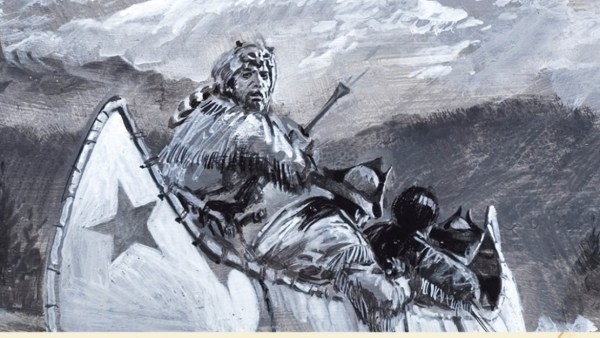
Illustration by Thea Brine.

About the Columnist
Jessa Crispin is the editor and founder of Bookslut.com. She is the books columnist for The Smart Set and has written for assorted publications, some of which are still in business. She has lived in Kansas, Texas, Chicago, and Ireland, and her personal library currently resides in Berlin.
Featured Title

February 23: John Keats died in Rome on this day in 1821. In his last letter, three months before his death, Keats shared premonitions of his famous "writ in water" epitaph: "I have an habitual feeling of my real life having [passed],…

In our increasingly digitally-dominated world, any book that attempts to explain for the layperson "the ingenious ideas that drive today's computers" should find a ready audience…

Books CDs, DVDs to know about now
The Lady in Gold

With its graceful subject gazing out from a shimmering peacock's tail of a dress, Gustav Klimt's gold-flecked 1907 portrait of Adele Bloch-Bauer has an equally spectacular backstory, complete with a breathtaking woman, turn-of-the-century Viennese society, Nazis, and, of course, an inspired painter. Anne-Marie O'Connor sweeps us up in this true story of high art and high-stakes intrigue.

Girlchild

In her debut novel, Tupelo Hassman channels the brash but vulnerable voice of Rory Dawn Hendrix, a young girl growing up in a seedy Reno trailer park. Determined not to follow the going-nowhere path prescribed for her -- the one her Mama is currently on -- Rory checks out the Girl Scout Handbook from her school library over and over again, even though she isn't in a troop. Will advice on subjects like "Finding Your Way When You Get Lost" help her escape?

Brave Dragons

The Shanxi Brave Dragons were among China's worst basketball teams when team owner Boss Wang hired NBA coach Bob Weiss to help them improve. Wang promised Weiss he would be able to employ his American methods, but things didn't exactly play out that way. This illuminating book by former New York Times Beijing bureau chief Jim Yardley reveals as much about China and America as it does about the sport at its heart.